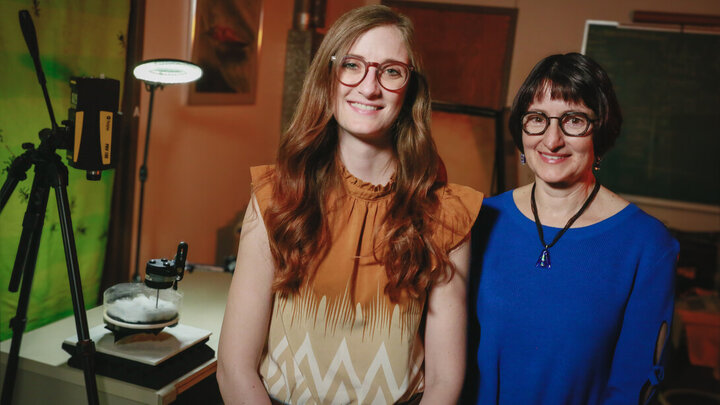
Brandi Pessman, a postdoctoral researcher in the School of Biological Sciences, and Eileen Hebets, George Holmes Professor of biological sciences, published an April study demonstrating that the webs of funnel-weaving spiders transmit vibrations differently in response to increased local environmental noise. This flexibility in web transmission properties suggests that the spiders may intentionally spin their webs differently to manage surrounding noise and receive crucial sensory information. Stories on the research appeared in KHGI, Earth.com, The New York Times and Smithsonian Magazine.
Annual flu shots could become a thing of the past under a new vaccine strategy developed and tested by Husker virologist Eric Weaver and his laboratory team. In an April study, the team described a vaccine that protects against H1N1 swine flu and can also protect against influenza in humans and birds. Stories on the research appeared in at least five Nebraska media outets, Farms.com, The Microbiologist, National Hog Farmer and several other national outlets.
Taking a cue from ocean-dwelling species, Stephin Morin, associate professor of chemistry, and colleagues are developing synthetic skins that will support the emergence of next-generation “soft” machines, robots and other devices. The skins closely approximate the mechanical action of the chromatophores found in cephalopods — squids, octopi, cuttlefish and other species. Articles on the research appeared in Interesting Engineering, Phys.org, Scienmag and Sustainability Times.
Mark Brittenham and Susan Hermiller, both professors of mathematics, recently solved a decades-old problem in knot theory. The researchers found that larger and seemingly more complex knots created by joining two simpler ones together can sometimes be easier to undo than simple ones — the opposite of what was expected. The finding was featured in New Scientist, Quanta Magazine, Scientific American and Stand-up Maths. It was also included in Scientific American's "10 biggest math breakthroughs of 2025" on Dec. 19.
An international team of scientists, led by Nebraska’s S. Kathleen Lyons, associate professor of biological sciences, is providing a new framework — Earth system engineering — for examining how organisms, including humans, have fundamentally altered ecosystems on a global scale across hundreds, thousands or millions of years. Stories on the research appeared in Phys.org and Terra Daily.
The university fared well in many national rankings throughout the year. The University of Nebraska system landed among the top 100 universities with the most U.S. utility patents granted in the 2024 calendar year, Silicon Prairie News reported June 26. NU’s 47 patents ranked No. 49 in the U.S. and No. 82 in the world, according to the list compiled by the National Academy of Inventors. Thirty-six patents were awarded to projects led by Husker researchers. Nebraska remains the top-ranked university in the state and No. 10 in the Midwest. Stories on the ranking appeared in KHGI, Silicon Prairie News and Tri-State Livestock News.
Alice J. Kang, professor of political science and ethnic studies, co-wrote a June 3 piece for The Conversation on the lack of female political leaders in Nigeria shaping children’s views. “Our finding that children largely see politics as a ‘man’s world’ prompts reflection on societal and political biases,” the co-authors wrote. “To address the under-representation of women in political leadership positions in Nigeria, it is important to invest in civic education programs.”
A sample of additional expertise quoted:
- Dona-Gene Barton, political science, August in The Guardian, Senate race between incumbent Pete Ricketts and challenger Dan Osborn.
- Eve Brank, psychology, July in St. Louis Post-Dispatch, St. Louis police possibly citing parents for their children’s actions at future public events, as they did over July Fourth weekend.
- Kelsy Burke, sociology, August in Time magazine, religious opposition to trans health care being relatively new phenomenon; October in The New York Times, renewed debate over conversion therapy for LGBTQ youth.
- Adam Houston, Earth and atmospheric sciences, April on CNN, deadly tornado outbreak in southeast United States.
- Ari Kohen, political science, December in CNN, the psychology of heroism.