DNA fascination evolved into groundbreaking research and education programs
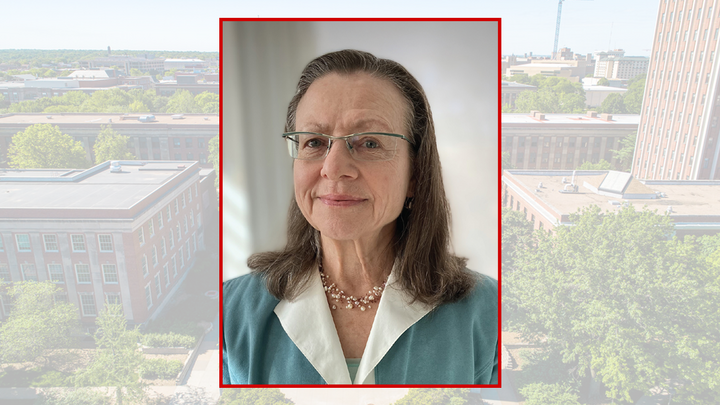
When Russette Lyons (’78, ’85) arrived at the University of Nebraska-Lincoln to attend graduate school, she was searching for a place to explore her growing interest in genetics. What she found was a community of mentors, collaborators and friends who helped shape the trajectory of her life and career.
In April Lyons was recognized as an Alumni Master by the Nebraska Alumni Association, an honor she says she never expected. “I look at my career and say, ‘I’m proud of it,’” Lyons said. “I did good things, but I couldn’t imagine that it would ever be recognized as outstanding or anything.”
That humility stands in contrast to a career that has spanned groundbreaking biomedical research, biotech leadership and global scientific education.
Lyons first discovered her passion for genetics as an undergraduate at the State University of New York at Binghamton. At a time when scientists were only beginning to unlock the mysteries of DNA, she found herself captivated by the subject. “It was the first biological sciences class that really clicked for me,” she said. “I could actually picture what they were talking about.”
Seeking a graduate program where she could deepen that interest, Lyons enrolled at Nebraska, where she studied under genetics professor Dwight Miller. There, she immersed herself in research using fruit flies, one of genetics’ earliest model organisms.
Her work ranged from breeding studies to behavioral experiments designed to understand how fruit flies navigate their environment. She trapped flies in the field using homemade banana mash bait and even conducted maze experiments to determine which senses they relied on to find food.
After earning her master’s degree, Lyons remained at Nebraska, working as a laboratory technician before pursuing a doctorate. The experience exposed her to every aspect of research, from conducting experiments to maintaining the lab itself. “I got very good at it,” Lyons said. “You know, being able to take care of everything in the lab, do whatever needed to be done.”
Her doctoral research on proteins involved in cellular growth control helped prepare her for a postdoctoral fellowship studying cancer biology and protein biochemistry. From there, she faced a choice between academia and industry.
She chose industry.
In the early 1990s, Lyons joined Genetic Therapy, a small biotechnology company exploring the then-emerging field of gene therapy. The company would become one of the first to treat patients with a rare genetic disease using gene therapy technology. “It was just amazing that it happened so quickly,” Lyons said.
Over time, she advanced through a series of leadership roles, overseeing cell biology and molecular biology programs before eventually becoming head of research and development and chief operating officer. Yet despite her success in executive positions, Lyons found herself most energized by the science itself. “I really was much more happy being closely associated with the research,” she said. “Whether it was actually at the bench or supporting research in some way, but not at kind of a business level.
That passion followed her to Novartis, where she worked in project management, vaccine development and scientific education. One of the highlights of her career came through work associated with a meningitis vaccine that ultimately received regulatory approval.
But it was education that would become her lasting focus.
At Novartis, Lyons helped create programs for students at nearly every stage of the scientific pipeline, from middle and high school laboratory experiences to college internships, postbaccalaureate research fellowships, and postdoctoral training opportunities. “It really feels like coming back full circle,” she said.
The programs reflected something Lyons wished had existed during her own graduate school years: a stronger sense of community and mentorship for young scientists navigating their careers.
That commitment to helping others comes as no surprise to those who knew her during her time in Lincoln. Sue (Mittag) Alker (’83), a former housemate and longtime friend, remembers Lyons as someone who naturally connected people. “She was very down-to-earth and had a wonderful sense of humor,” Alker said.
The two lived together while attending school, and Alker recalls Lyons frequently hosting dinners for friends from the lab. “She enjoyed making homemade pasta and inviting her lab friends over for dinners, and the house smelled wonderful,” Alker said.
The friendship left a lasting impression. When Alker got married, Lyons gave her the same pasta maker she used herself. “I still use it to this day,” Alker said.
Outside the lab, Lyons was equally competitive on the tennis court. Bruce Poe (’85), who met Lyons while both were graduate students at Nebraska, remembers her as a gifted athlete whose determination matched her academic drive.
“Russ was, and probably still is, always smiling and upbeat about everything,” Poe said. “Behind that smile is a very bright and competitive person.”
The two frequently partnered in local mixed doubles tournaments, where Lyons quickly earned a reputation for her intensity. “When the bottom line is winning or losing, don’t mess with Russ,” Poe said. “She will grind you into the court and smile as she is doing it.”
Poe said the same qualities that made Lyons successful in sports would later define her professional life. “She was a bright, passionate and caring person who had goals and would excel at anything she participated in,” he said.
As Lyons reflects on her years at Nebraska, she remembers gradually learning that graduate school was about more than research. Initially focused almost entirely on academics, she eventually embraced campus traditions, friendships and activities that helped create a fuller experience.
Asked to describe her perfect day as a graduate student, her answer was simple: “Tennis, tennis, lab, lab, beer.” The formula captures much of what defined her time at Nebraska — intellectual curiosity, hard work, friendship, and fun.
Today, Lyons hopes students understand that successful careers rarely unfold according to a master plan. “Careers are not straight lines,” she said. “If you put in the effort, work hard, show your motivation and determination, opportunities come to you.”
It is advice grounded in experience. From studying fruit fly genetics in Nebraska to helping pioneer gene therapy and mentoring future scientists, Lyons built a career by embracing opportunities she never could have predicted.
Looking back, she credits hard work more than anything else. “The harder I work, the more luck I find,” she said.